Google for Creators: Why Google Just Built an Identity Layer for Humans
Google spent two years building systems that answer questions without sending anyone to a website. Then, in June 2026, it quietly built the opposite thing: a verified home page for the humans behind the content. That is what creators.google is now, and it tells you more about where search is heading than any AI announcement this year.
Most coverage treated it as a vanity feature. Claim your profile, add a nicer avatar, pin a few posts. That reading misses the point. Search profiles are Google building an identity layer underneath a discovery system that increasingly answers without attribution. When machines summarize everything, the scarce asset stops being content and starts being a verifiable person standing behind it.
Here is what the platform actually offers, what changed in August, what it means if you are nowhere near the follower threshold, and the one detail almost nobody is discussing.
What creators.google Actually Is
Google for Creators is not new. It launched back in October 2021 as an education hub — guides on finding a niche, building a content strategy, growing an audience. For years it was essentially a library.
In 2026 it became a product surface. The site now organizes around four things:
- Search Profile — a claimable, verified page that controls how you appear when someone searches your name or handle.
- Search Console — the same reporting tool site owners have used for years, now extended to social and video accounts as separate properties.
- Discover — the feed in the Google app, where your content and your profile can be surfaced to people browsing their interests rather than searching for you.
- Community — a Discord where Google talks directly to creators.
Google’s own framing on the site is plain: it “offers you tools, products, and guidance to help establish, grow, and build your brand.” The interesting part is that three of those four pillars did not exist in this form eighteen months ago.
Search Profiles: What Google Announced
On June 4, 2026, Google published the announcement on both the main Google blog and the YouTube blog — a two-front rollout that signals how much weight it carries internally. The Google post described it directly: “Search profiles give publishers and creators a central place to showcase their latest articles, videos and social posts.”
Practically, a claimed profile lets you set:
- An avatar and a bio you write yourself
- Your primary website link
- Linked social and video platform accounts
- Pinned posts pulled in automatically through platform APIs
- Additional external links
Third-party guides have reported caps in the range of eight pinned posts and eight links, with pinned content limited to the trailing year. Google’s own documentation does not publish those numbers, so treat them as observed rather than official.
Your profile can be reached three ways: a button on your Knowledge Panel in mobile Search, a tap through from your content in Discover, or a direct URL you can share. After claiming, you manage it at profile.google.com/account or through your avatar in the Google app.
Verification is the part worth noticing. During setup, in Google’s words, “you’ll be asked to log in to and link your supported platforms to verify your identity.” You are not filling out a form. You are proving control of accounts. That is an identity check, not a profile editor.
The Eligibility Bar Dropped Hard in August
At launch, Search profiles were effectively a feature for established media personalities. The original thresholds were roughly 100,000 followers on YouTube, Instagram, or X, or 300,000 on TikTok.
On August 16, 2026, that changed. Google’s current eligibility language on creators.google states you need to be “an individual creator, publisher, or organization who is actively creating content” with “a public profile with at least 35,000 followers on a single supported platform—Instagram, TikTok, YouTube, or X.” Reporting at the time of the change noted TikTok’s bar coming down from 300,000 to 100,000 in the same update.
Check the number yourself before you plan around it
Google has already moved this threshold once in under three months, and the official page and press coverage have not always agreed on the per-platform detail. If eligibility is close for you, verify it directly on creators.google/profile rather than trusting any secondhand figure — including this one.
A roughly two-thirds cut in the requirement, ten weeks after launch, is not a minor tuning pass. It is Google discovering it needs far more verified identities in the system than the launch cohort provided.
Search profiles remain US-only for now, with Google stating it will “look to expand Search profiles to more publishers and creators around the world, and add more capabilities to make profiles even more useful.”
Read the Timing, Not the Press Release
This did not arrive in a vacuum. It arrived in the middle of the worst referral-traffic environment the open web has ever had.
The numbers are ugly and well documented. A study covered by Search Engine Land in early 2026 put zero-click Google searches at roughly 68% — searches that end without a click to any website. Seer Interactive’s analysis found organic click-through rates dropped about 61% when an AI Overview was present, measured between June 2024 and September 2025. Publishers have reported far steeper individual losses.
So Google built AI answers that consume content without forwarding the traffic, and then built a product that gives creators a Google-hosted page instead. Variety’s coverage made the connection explicit in its headline, tying the Search profiles launch directly to the AI-summary referral drop-off.
You can read that cynically — a consolation prize, a retention play, another surface where the destination is Google. That reading is fair. But it is incomplete, and the incomplete part is the useful part.
What Google Actually Needs Is Provenance
Here is the structural problem Google has, stated plainly. Generative systems produce fluent text at effectively zero marginal cost. The open web is filling with content that has no identifiable author, no accountability, and no way to verify whether a human ever checked it. Google’s ranking systems were built on the assumption that pages are expensive to make and links are meaningful votes. Both assumptions are eroding fast.
When content becomes free to generate, the signal that survives is who made it and can you confirm that.
Search profiles are Google building exactly that: a graph of verified humans, tied to platform accounts they demonstrably control, with content attributed back to them. It is not a courtesy to creators. It is infrastructure Google needs in order to keep telling good sources from generated noise.
Which is why I read the follower threshold drop as the most revealing detail of the whole rollout. Google is not rationing this. It is recruiting.
The Detail Nobody Is Discussing: Google Writes Part of Your Bio
Buried in Google’s support documentation is a line that deserves far more attention than it has received. Once you claim a profile, your Knowledge Panel may display “an AI-generated summary based on your bio.”
Sit with that for a second. You write a bio. Google’s model reads it and writes a different bio. That generated version is what a meaningful share of people will actually read when they look you up.
This is the human side of AI development in its most literal form — a machine paraphrasing your professional identity to strangers, at scale, without your sign-off on the final wording. It is distinct from AI Overviews, which answer queries. This one describes you.
The practical implication is specific and actionable: write your bio as source material for a summarizer, not as marketing copy.
- Lead with unambiguous facts. Role, discipline, location, what you actually build or cover. Models compress reliably when the input is concrete.
- Kill the hedged adjectives. “Passionate about innovative solutions” survives summarization as nothing at all. “Builds AI search visibility systems for service businesses” survives intact.
- Front-load the sentence you’d accept as the whole summary. Assume the first clause is the only clause that makes it through.
- Stay consistent with everything else Google can see. If your bio, your site’s Person schema, your LinkedIn headline, and your YouTube About page describe four different people, the summarizer will average them into mush.
- Re-read it after claiming. Then check again in a month. This is generated output, and generated output drifts.
There is a broader principle here that applies well beyond this one feature. Increasingly, you are not writing for readers. You are writing for a model that will describe you to readers. Clarity has stopped being a stylistic preference and become a distribution requirement.
What If You’re Nowhere Near 35,000 Followers?
Most business owners reading this are not eligible, will not be eligible soon, and should not care very much. The tactic is gated. The underlying shift is not.
Search profiles are the visible tip of something I’ve written about here before: Google moving from indexing pages to resolving entities. That shift is already fully live for businesses that will never claim a creator profile, and it runs through Search Console platform properties, Google Business Profile, structured data, and author signals.
The work that makes a Search profile valuable is the same work that makes you legible without one:
- One consistent identity across every surface. Same name, same description, same website URL, same core topics — on your site, your Business Profile, and every social account.
- Real author pages with real credentials. Not a byline. A page that explains who this person is and why they can speak to this.
- Honest
sameAsschema connecting your Organization or Person entity to the profiles you genuinely control. - Platform accounts added to Search Console where the option is available, so you can see what your off-site content is doing in Search. I wrote the step-by-step for that in this walkthrough.
- Content that is attributable — first-hand examples, named case studies, specific numbers, an actual point of view. That is the same requirement driving citations in ChatGPT, Perplexity, and Gemini.
If you do that work, you are ready the day the threshold drops again. And it will drop again.
Setup Checklist for Eligible Creators
- Check eligibility first at creators.google/profile before planning anything around it.
- Audit your platform accounts for public visibility and accurate handles before you start linking.
- Claim and verify by logging into and linking each supported platform.
- Write the bio for a summarizer using the rules above — facts first, no filler.
- Point the website link at your strongest page, not reflexively at your homepage. If one page best explains what you do, send them there.
- Pin content that represents the work, not just the content that performed well. This is an identity page, not a highlight reel.
- Search your own name on mobile afterward and look at what actually renders in the Knowledge Panel.
- Read the AI-generated summary carefully and adjust your source bio if it lands wrong.
- Align your on-site Person schema with what the profile now says.
- Recheck quarterly. Google is actively changing this surface.
What Not to Do
Do not treat a Search profile as a ranking lever. It controls presentation and identity. It is not a shortcut to visibility for your content, and nothing in Google’s documentation suggests otherwise.
Do not chase 35,000 followers to unlock it. Buying your way to a threshold produces an audience that confirms nothing about your credibility, which is the entire thing the feature exists to establish.
Do not let a Google-hosted page substitute for the one you own. Your site is the only surface where you set the rules, keep the email addresses, and control what happens next. Search profiles are a front door, not a house.
Do not accept the AI-generated summary without reading it. It is the version of you that most people will see, and you influence it only through the input you provide.
The Bottom Line
The story of AI in search over the last two years has been machines getting better at answering without humans in the loop. Search profiles are the counter-move, from the same company, in the same quarter: an infrastructure bet that as generated content approaches infinite supply, verified human identity becomes the scarce input.
Google needs to know who is real. That is now a product requirement, not a philosophy.
Which means the durable advantage is not learning to prompt better or publishing more. It is being a specific, identifiable, consistently-described person or business that a machine can resolve with confidence and a human can decide to trust. That has always been the honest version of the job. The difference is that the infrastructure finally rewards it.
Want to Know If AI Search Can Actually See You?
I built the Free AI Search Readiness Scanner to check the technical signals that let AI engines understand a site and the entity behind it. For a deeper review, the AI Visibility Snapshot tests whether ChatGPT, Perplexity, and Google’s AI experiences can find and correctly describe your business, then hands you a prioritized fix list.
Build an Entity Google Can’t Misread
Consistent identity across your site, schema, profiles, and content — engineered so both search engines and AI systems describe you the way you’d describe yourself.
I Built a Free Scanner That Shows If Google’s AI Can See Your Business (Mine Failed)
Google just held a funeral for the 10 blue links, and most business owners didn’t get an invitation.
At I/O this year, Google announced the biggest change to the search box in 25 years. When your next customer asks Google’s AI Mode, ChatGPT, or Perplexity “who’s the best roofer near me” — the AI gives one answer. There’s no page two. There’s barely a page one. You’re either the answer, or you’re invisible.

So I built a scanner. Then I pointed it at my own site.
Twenty years of engineering pride, two years of vibe coding, and here’s what happened when I ran my own free AI Search Readiness Scanner against chrisslater.ai:
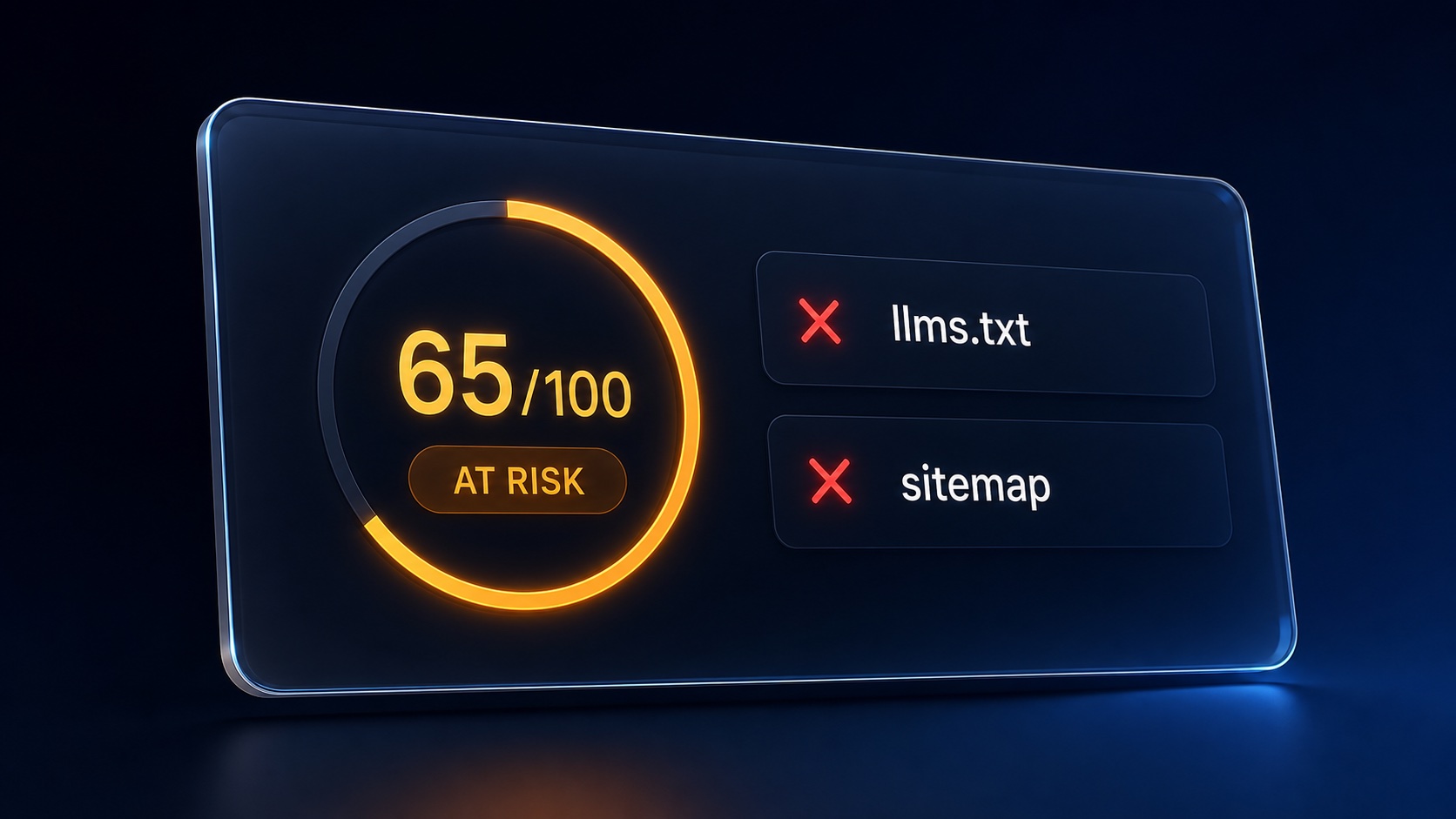
65 out of 100. “At Risk.”
No llms.txt. No sitemap. No business schema. My site — the site of a guy who literally sells AI visibility services — was semi-invisible to the machines deciding who gets recommended. I’m publishing that number because that’s the point: almost everyone is failing this test right now, and almost nobody knows it.
What the scanner actually checks (in 30 seconds, free, no email)
It reads your site the way an AI engine does and grades 12 signals in plain English:
- Can AI even get in? Some sites block GPTBot, ClaudeBot, and PerplexityBot in robots.txt without knowing it. That’s a self-inflicted disappearing act.
- Do you have an llms.txt? The new standard file that tells AI assistants who you are and why to recommend you. Most sites: no.
- Does AI know what your business IS? Structured data (schema) is how machines learn your name, location, and services. No schema = the AI is guessing.
- Do you answer questions? AI answers are stitched from Q&A content. Sites with no FAQ rarely get quoted.
- Can crawlers read your words? If your beautiful site loads everything with JavaScript, most AI crawlers see a blank page. One site in my own portfolio exposed just 120 words.
The uncomfortable truth about this moment
Here’s the part I care about, and the reason I don’t write pure-hype AI posts: this shift is going to quietly hurt a lot of good people. The bakery with the JavaScript menu. The contractor whose 15 years of reviews live on a site AI can’t parse. They did nothing wrong — the ground moved under them.
But the same shift is the biggest visibility opportunity since early Google. The fixes are not rocket science: a text file here, a schema block there, an FAQ page written in the words your customers actually use. The businesses that do this in the next six months get cited while their competitors vanish. Cited brands are already earning about 35% more clicks. This is a rare window where an afternoon of unglamorous work beats a decade of incumbency.

Run your scan. Right now. It’s free.
→ Scan your site free at the AI Search Readiness Scanner — 30 seconds, no signup, nothing stored.
If you score under 80, you have gaps costing you AI visibility today. Fix them yourself with the toolkit at All Clear Digital, or get the done-for-you audit at Lexington Digital.
As for me — I’m taking my own medicine. llms.txt, sitemap, and schema go live on this site this week. I’ll post the before/after score.
A New Day
A New Day: Building Legacy, Not Just Launches
Today isn’t just another day to work.
It’s a day to build something that matters.
After 25 years online — launching products, serving clients, and building the kind of infrastructure others dream of — I’ve decided that this next chapter won’t be about more hustle.
It’s about inspired work.
Work that leaves a mark, not just a metric.
Build Legacy, Not Just Revenue
Launching AI products and services is exciting — but let’s be honest — anyone with enough drive and a few tools can do that today.
The real difference comes when you stop chasing launches… and start designing an ecosystem.
I want to build something that shapes how others build. A body of work that outlives the moment.
That means asking a better question at the start of every project:
“Will this still matter five years from now?”
Legacy isn’t built by accident. It’s built by intention.
Work in “Signature Mode”
At this point in my journey, I’m no longer trying to out-hustle anyone.
I’m creating work that can’t be replicated because it carries my signature.
Every product. Every campaign. Every client strategy.
-
Bold vision.
-
Smart architecture.
-
Seamless integration of AI, GEO, AEO, and SEO.
-
Experiences that feel different.
I delegate the ordinary.
I obsess over the extraordinary.
Excellence isn’t about doing more.
It’s about doing what only you can do.
Build an “Inspiration Engine”
Inspiration isn’t random. It can be engineered.
That’s why I’ve created a simple daily ignition loop:
-
Morning: Review one breakthrough idea in AI or strategy.
-
Midday: Ship one high-impact action tied to a big vision.
-
Evening: Reflect on what felt energizing, not just productive.
In 30 days, momentum turns into movement.
This isn’t about discipline — it’s about rhythm.
Elevate Clients by Elevating the Game
I offer GEO/AEO/SEO services — but my real value isn’t in the service.
It’s in the strategy behind it.
I’m done just “delivering results.”
I want to architect growth systems that give my clients compounding advantages.
AI isn’t just a tool. It’s a multiplier.
When I stop thinking like a provider and start operating like a strategic partner, everything changes — for me and for them.
Lead Like a Lighthouse
Many experienced entrepreneurs spend their late seasons executing harder.
The inspired ones become beacons.
They speak.
They share frameworks.
They shape industries, not just serve them.
I intend to step forward as one of them.
My 25 years aren’t just a résumé — they’re a platform of authority.
Final Thought
“The next decade isn’t about finding the next big thing.
It’s about being the next big thing in your space.”
I have the infrastructure.
I have the experience.
Now I’m choosing inspired creation over constant execution.
This is my new era.
Not just to build — but to build with intention.
Legacy isn’t about the number of things you launch.
It’s about the depth of what you create.
Here’s to doing work that matters. Not just for today — but for years to come.
From SEO to GEO: Embracing the AI-Driven Shift in Content & Discovery
If you’ve been around the web long enough, you already know change is the only constant. But over the the last year, the tectonic plates under search and content have shifted in a way that demands a new mindset. The old rules still matter — but they no longer guarantee results on their own.
In this post, I’m walking through how we’re evolving from traditional SEO and content creation to GEO (Generative Engine Optimization) and AI-driven content strategies, what’s changed, and how I’m helping my clients thrive in this new era.
Why SEO Alone Isn’t Enough Anymore
Traditional SEO — keywords, backlinks, technical fixes, content depth, crawlability, link equity — has served us well. It’s how sites got found, how blogs got traffic, how businesses scaled online. But a few key shifts are eroding its solo dominance:
-
AI summary / “answer boxes” / AI Overviews: Search engines are increasingly surfacing synthesized, conversational answers (e.g. Google’s AI Overviews) above or in place of “blue link” results. That means users may get their answer before they ever click through.
-
Zero-click behavior: People are getting what they need without ever visiting your site. Even if your content is perfect, you might miss out on the click — unless you’re being cited.
-
Opaque ranking & selection in AI engines: The models and systems deciding which sources to pull from are black boxes. Your content needs to be organized, trustworthy, and structured so the AI chooses you.
-
New evaluation signals: It’s not just about which page ranks #1. It’s about which sources get cited by AI, which content is “ingested” into models, and which domains are trusted by machine learners.
All of this doesn’t mean SEO is dead — far from it. Instead, SEO becomes the foundation plus a new overlay: the GEO mindset.
What Is GEO (Generative Engine Optimization)?
GEO is the practice of optimizing content so that AI-powered search engines (generative models, answer engines) select, quote, or cite your content when synthesizing answers. In other words:
-
SEO = get found
-
GEO = get featured
GEO is sometimes also called AEO (Answer Engine Optimization) or AI Search Optimization — there’s no universal naming yet. But the core is consistent: structure, clarity, trust, and entity-level signals matter more than ever.
Some key distinctions:
|
Feature |
Traditional SEO Focus |
GEO / AI Search Focus |
|---|---|---|
|
Goal |
Ranking, clicks |
Inclusion in AI-generated answers / citations |
|
Content format |
Long-form pages, topical depth |
TL;DRs, lists, Q&A, conversational chunks |
|
Signals |
Backlinks, domain authority, content depth |
Entity authority, schema/structured data, cross-source citations |
|
Metrics |
Traffic, ranking position, CTR |
AI mentions, citation share, “visibility in generative results” |
The academic world is even formalizing GEO. In a 2023 paper, researchers defined GEO as a new paradigm to raise the odds of being cited in generative engine responses. In a recent follow-up, they analyze biases (for example, AI favoring “earned media” over brand-owned content) and propose strategies to overcome them.
What It Takes: How to Transition From SEO → GEO
Switching your client’s strategy (or your own) from SEO-only to SEO + GEO is not trivial — but here’s the roadmap I use.
1. Strengthen the SEO foundation (it still matters)
Before you can optimize for AI, you need a solid base:
-
Fast, reliable site performance
-
Clean, crawlable HTML (minimize JavaScript obstacles)
-
Good internal linking and site structure
-
Core on-page optimization: tags, headings, alt text, etc.
-
High-quality content (depth, clarity, use cases)
If your SEO is shaky, AI engines won’t trust or use your content.
2. Structure for AI readability & extraction
AI loves well-organized, machine-friendly content. Some tactics I deploy:
-
Use schema / structured data (FAQPage, HowTo, Article, Organization) so AI knows what your content is.
-
Break content into logical “chunks” (questions + answers, bullet points, mini summaries) to make extraction easier.
-
Use TL;DR / summary boxes — highlight the core takeaway right up front.
-
Use conversational / question-based headings.
-
Cite external sources, use quotes, embed trust signals (expert validation, data) — things AI can cross-check.
3. Build entity authority & cross-source signals
AI engines rely heavily on trust, entity recognition, and cross-source verification. The strategies I lean on include:
-
Strengthening your brand’s “entity footprint”: knowledge panels, author profiles, published interviews, speaking contributions, etc.
-
Earning mentions and citations in reliable, authoritative sources.
-
Maintaining consistency across your brand’s signals (e.g. business listings, Wikipedia (if viable), social footprint).
-
Monitoring “AI citations / mentions” via tools that track how often your content is pulled into AI responses.
-
Using structured linking to related materials, building a web of content that supports your core topics.
4. Adapt content strategy: from volume to prominence
In the old SEO days, more content, more keywords, more coverage often paid off. Now:
-
Focus on high-impact topic hubs where you can be the definitive voice in AI responses.
-
Refresh and repurpose high-value content regularly (AI models often prefer up-to-date sources).
-
Create content around gaps where AI answers are weak or missing — be early.
-
Use AI tools (sensibly) to help ideate, outline, or test content formats — but always vet and improve with human judgment.
-
Resist filler content — AI engines often penalize low-value or generic material.
5. Reimagine KPIs & measurement
Because many users won’t click through, traditional traffic-based metrics are insufficient. Some new metrics to track:
-
AI citation / inclusion rate
-
“Zero-click” reach or impressions in generative snippets
-
Conversion / engagement from users who do visit
-
Share-of-voice in AI outputs
-
Domain / author reputation metrics
-
Content freshness / decay metrics
Also, set expectations with clients: GEO is experimental, evolving, and attribution will be messy. But the upside is early advantage.
What I’m Doing (and Planning) with My Clients
Here’s a peek into how I’m executing this for my projects (and I can tailor for you, too):
-
I audit client content to identify “AI-friendly” pages (Q&A content, step-by-step guides, explainers) and restructure them for cleaner extraction.
-
I layer in schema and structured metadata across those pages, ensuring our markup aligns with what AI systems expect.
-
I create a “citation outreach” plan: getting mentions, backlinks, and authority signals from well-known sites to support client authority.
-
I monitor AI engines (ChatGPT, Perplexity, Gemini) to see when and how client content is quoted — then iterate.
-
For new content, I plan with GEO in mind: each brief includes “how would AI parse this?” as a guiding question.
-
I benchmark and track hybrid metrics: not only traffic, but inclusion in AI outputs, assisting conversion, etc.
-
I proactively adjust — for example, if an AI engine changes how it selects sources, I’ll pivot fast.
Why This Pivot Is (Almost) Non-Negotiable
If you believe in owning your narrative, authority, and relationships with your audience, GEO isn’t optional — it’s evolutionary:
-
Traffic decline is real: Many publishers report significant drops in organic click-throughs as AI Overviews absorb attention.
-
First-mover advantage: The earlier you optimize for AI, the more likely you are to lock in citation gains and brand authority in generative responses.
-
Resilience against algorithm changes: AI engines are less about “gaming an algorithm” and more about trusting sources. If your content is built on authority, you’re more robust to change.
-
Better conversion potential: Users who do click are often better qualified — you’re not competing for every random visitor, but for meaningful ones.
-
Intrinsic alignment with E-E-A-T: GEO forces you to double down on Expertise, Experience, Authoritativeness, Trustworthiness — these remain central, now under AI’s lens.
Final Thoughts & What You Can Do Now
-
Start small: pick your best-performing content and GEO-optimize it (chunking, schema, quotes).
-
Build a measurement plan beyond traffic.
-
Monitor AI mentions — don’t wait for perfect tooling.
-
Think long term: GEO won’t fully stabilize overnight. Stay flexible.
-
Educate clients or stakeholders: many don’t realize that “being found” is evolving — they need to see why this matters.
Hello World! From SEO to AI: My New Chapter Online
From SEO to AI: My New Chapter Online
Hi, I’m Chris Slater — and this blog has been a long time coming.
For over 25 years, I’ve lived and worked online. From the early days of dial-up and hand-coded HTML to the rise of Google, social media, and now AI — I’ve seen (and helped shape) the digital world as we know it. Looking back, my biggest regret is that I didn’t blog any of it — the wins, the lessons, the mistakes, the breakthroughs. So, this blog fixes that.
A Little About Me
I’ve spent most of my professional life helping businesses grow through SEO — not just chasing rankings, but building systems that drive real results. Along the way, I’ve learned what it takes to stay relevant in an industry that never stops evolving.
Now, I’m entering a new era of my career — AI development and AI search. The web is transforming once again, and I’m fascinated by how artificial intelligence is redefining everything from how we find information to how we create it.
Why I’m Starting This Blog
This space is my chance to share — the knowledge, the stories, and the experiments. Expect insights on:
-
SEO strategies that still matter (and those that don’t)
-
AI tools and technologies I’m building or testing
-
Personal reflections on navigating change, growth, and creativity online
I’ll also be offering my services — from SEO consulting and AI-driven search strategy to custom AI integrations for digital businesses. But more than that, I’m here to connect.
Let’s Build Something Together
If you’re interested in collaborating, learning, or just talking about where the web is headed — reach out. I’m always up for new ideas, partnerships, or simply making new friends in this ever-evolving digital landscape.
Here’s to the next 25 years — and finally, to documenting the journey.
— Chris Slater
SEO Specialist, AI Developer, and Lifelong Web Explorer