The Silent Crisis on the Web: Why Your Website Is Losing Ground (And the Quiet Revolution Replacing Legacy Tech)
An Open Letter to Business Owners, Executives, and Forward-Thinking Technical Leaders
⚡ The Wake-Up Call
If your organic search visibility feels unpredictable, your paid customer acquisition costs are climbing, or your site feels sluggish and brittle compared to modern web apps, you aren’t imagining things.
Over the past eighteen months, Google and the search landscape have undergone their most aggressive evolution in over a decade:
Google no longer just matches keywords—it synthesizes and directly cites fast, semantically structured pages.
Monolithic platforms weighed down by 40+ plugins and slow database queries are systematically demoted.
Visitors demand app-grade speed. Anything over 1.5s causes users to bounce before your value proposition renders.
Almost every commercial website built on legacy CMS platforms is now operating with a massive structural handicap.
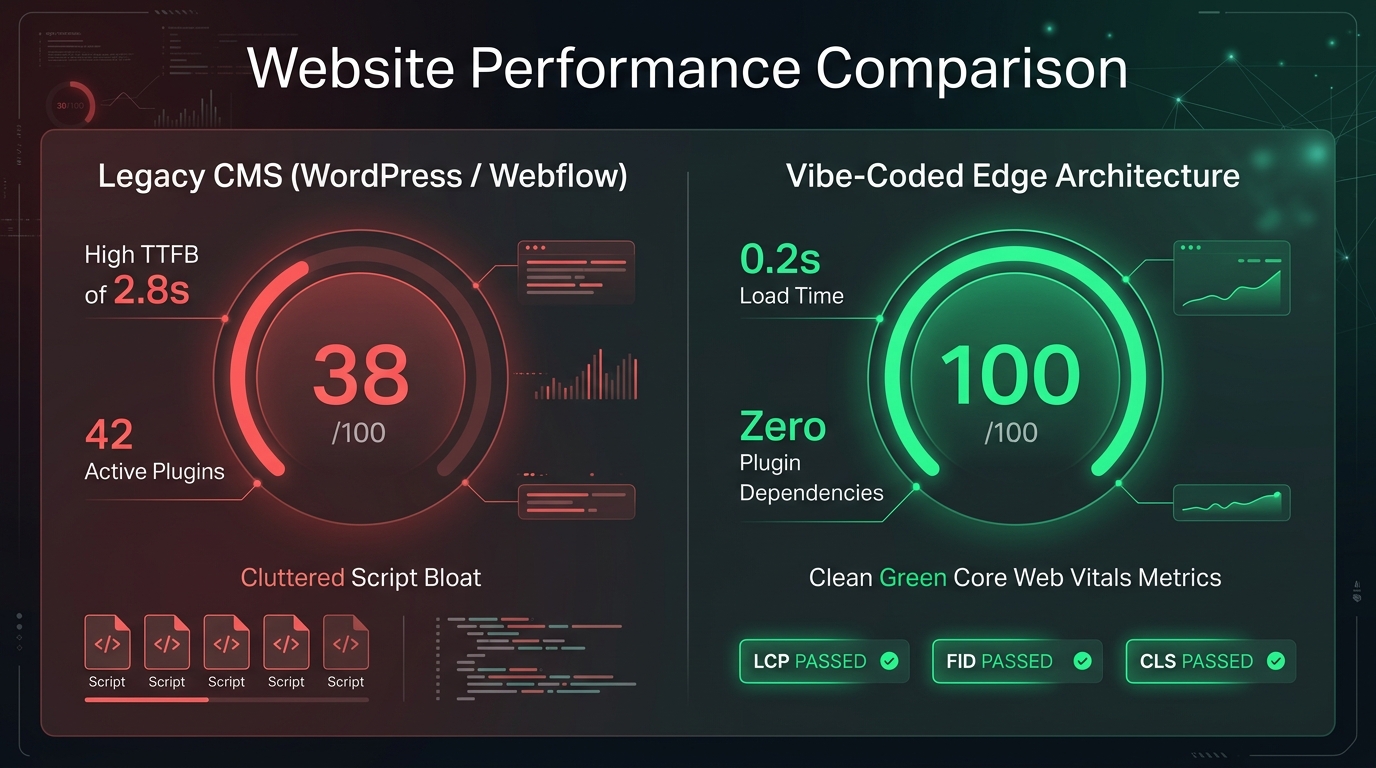
1. The Bottleneck of Popular Legacy CMS Platforms
Whether your company runs on WordPress, Webflow, HubSpot CMS, Shopify, Squarespace, Wix, or Drupal, you have likely bumped up against their fundamental architectural limits:
| Platform Category | Popular Tools | The Hidden Ceiling & Breaking Point |
|---|---|---|
| Monolithic Open Source | WordPress, Drupal |
Plugin bloat & security risks: Requires 30–50 plugins. One update breaks production; slow PHP/MySQL database roundtrips tank Core Web Vitals. |
| Visual Page Builders | Elementor, Divi, Beaver |
DOM nesting disaster: Generates thousands of lines of bloated HTML wrappers that search crawlers struggle to parse and choke mobile browsers. |
| Proprietary No-Code | Webflow, Wix, HubSpot, Squarespace |
Walled gardens & vendor lock-in: Escalating tier pricing, rigid limits on custom dynamic logic, and proprietary code exports that remain difficult to optimize. |
| E-Commerce Giants | Shopify (Liquid), WooCommerce |
Third-party app latency: Every marketing app and tracking pixel adds blocking JavaScript, creating 3–4 second delays on mobile checkout funnels. |
Routine plugin and server updates trigger silent breaks in contact forms, tracking pixels, or sales funnels, forcing costly ongoing agency retainers.
Google's Gemini-powered search models struggle to extract clear entity and schema relationships from messy legacy markup.
2. The Breakthrough: The Move to Vibe-Coded Architecture
You may have seen tech founders, senior engineers, and industry leaders talk about "Vibe Coding" and AI-Native Engineering.
Instead of spending weeks manually typing repetitive boilerplate, configuring server databases, and fighting template bugs, human domain experts partner with AI agents to construct tailored, high-performance web assets in days rather than months.
Every line of code exists solely for your conversion goals. Zero unused theme code or third-party overhead.
Custom pricing calculators, dynamic onboarding flows, and intelligent qualification tools built without enterprise budgets.
Ultra-fast global delivery via modern cloud edge networks, effortlessly achieving 95–100 Google PageSpeed scores.
Launch new campaign variations and interactive assets in hours instead of waiting for traditional agency sprint cycles.
3. The Intermediate Option: The "WordPress Hybrid" Bridge
We recognize a common dilemma: Your marketing team loves the familiar WordPress dashboard and simple "Publish" button, but your business cannot afford WordPress's sluggish front-end performance.
You don't have to throw away your editorial workflow to get modern speed. We offer a Headless WordPress Hybrid transition model.
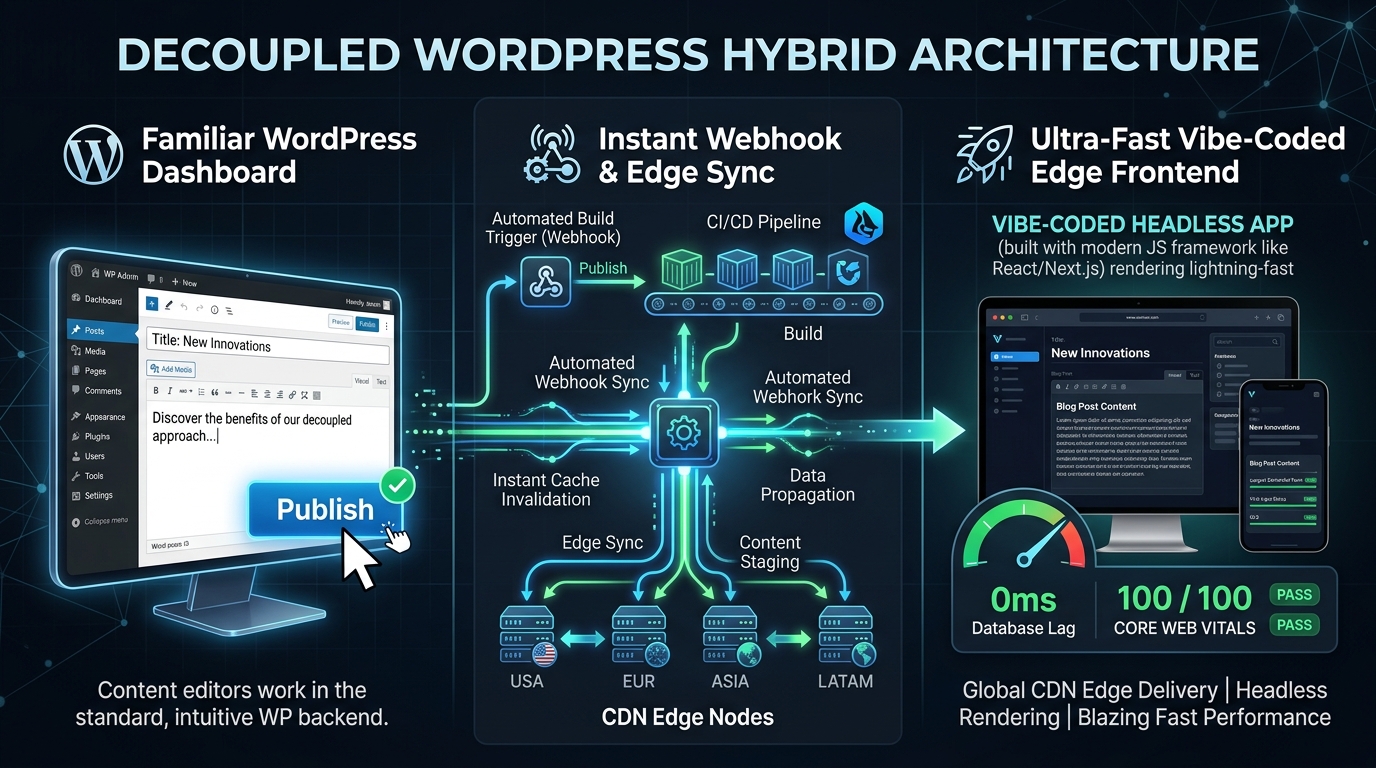
How the WordPress Hybrid Operates:
- Keep Your Familiar Dashboard: Your content team writes posts and edits copy in the standard WordPress admin panel.
- Instant Webhook Sync: The moment you click the blue "Publish" or "Update" button, a secure webhook signals our modern edge architecture.
- Ultra-Fast Edge Revalidation: The vibe-coded front-end rebuilds and revalidates that page in milliseconds across global CDN edge nodes.
- Best of Both Worlds: Editors keep the workflow they know, while your customers and Google get a blazing-fast, 100/100 Core Web Vitals experience with zero database lag and zero public-facing WordPress security vulnerabilities.
4. What This Means for Every Stakeholder
Maximum ROI: Eliminate plugin retainers and cut dev costs by 70%.
Moat: Deploy interactive tools competitors on template builders cannot match.
Lower CAC: Sub-second page loads reduce ad bounce rates and lower CPC.
AI Citations: Native JSON-LD schemas and clean semantic structure for Google AI Overviews.
Clean Modern Stack: Modular TypeScript, modern CSS, and edge-first rendering.
Zero Tech Debt: No hidden database vulnerabilities or fragile plugin conflicts.
5. Under the Hood: Technical Comparison
| Dimension | Legacy CMS (WordPress, Webflow, Wix, HubSpot) | Modern Vibe-Coded Architecture |
|---|---|---|
| Rendering Model | Server-side PHP / database queries on each hit or heavy client hydration | Pre-rendered static edge assets with selective interactive islands |
| Asset Overhead | 2–5MB+ per page with dozens of unused plugin scripts | Minified, tree-shaken bundles (<150KB total asset payload) |
| Security Surface | Vulnerable to SQL injections, plugin exploits, and brute force attacks | Near-zero attack surface (immutable static assets + isolated API routes) |
| Search Engine Parsing | Bloated markup with generic meta-plugin wrappers | Native semantic hierarchy + rich structured JSON-LD entity graphs |
| Maintenance Burden | Constant plugin patch cycles and breaking updates | Zero runtime maintenance; immutable git-backed deployments |
Ready to Modernize Your Digital Asset?
Continuing to band-aid legacy software stacks is an ongoing drain on marketing budget and team morale. Let’s look at the hard data for your site.
Where your current site is losing visitors under Google's latest updates.
Breakdown of plugin bloat and Core Web Vitals bottlenecks.
A visual blueprint of what your site looks like rebuilt on a modern stack.