Beyond Chatbots: How Custom AI Agents Are Revolutionizing Operations
The direct answer: custom AI agents go beyond chatbots because they take action inside your systems instead of just answering questions about them. A chatbot responds. An agent works through a task using the tools and data you connect it to, and hands back a result instead of a reply you still have to act on. Whether that counts as “revolutionizing operations” depends almost entirely on how narrowly you scope what the agent is allowed to touch.
What separates an agent from a chatbot
A chatbot is built to hold a conversation. An agent is built to finish a task. The practical difference is action: an agent can be given a goal, break it into steps, and work through those steps using connected tools and data, rather than generating text and waiting for a person to act on it.
That distinction matters more than the term itself. A lot of what gets marketed as “agentic” is still a chatbot with a longer prompt attached. A real agent has defined boundaries: what it’s allowed to read, what it’s allowed to write to, and what it has to hand back to a human instead of deciding on its own. The build work is mostly in those boundaries, not in the model doing the talking.
This is also where most agent projects go wrong. It’s easy to demo an agent that looks impressive on a narrow, pre-staged example. It’s much harder to run one against the messy, inconsistent reality of a live business process — half-updated records, customers who ask for something outside the script, systems that were never designed to be read by software instead of people. An agent that only works on the clean path isn’t done yet, no matter how good the demo looked.
Where this fits
My own work in this space is what the site calls custom autonomous agents: purpose-built AI agents that handle research, operations, and customer work around the clock. That’s a narrower promise than “revolutionizing operations,” and it’s the more honest one — an agent earns its place by doing one job reliably, not by replacing a department overnight. The useful question isn’t whether an agent can technically do a task; it’s whether it can do that task correctly, consistently, and safely enough that a human doesn’t have to double-check it every time.
That usually means starting with one process, not a department. Pick the task that’s repetitive, well-defined, and painful enough that getting it automated is worth the effort of defining its boundaries properly. Prove it there before expanding it anywhere else. An agent that works well on one narrow process is worth more than five agents that mostly work on everything.
The human side of this, which isn’t optional
Every agent that takes over a task was previously done by a person, and that’s worth saying plainly instead of skipping past it. Repetitive first-line work — ticket triage, status lookups, routine data entry — is exactly what agents are good at, and it’s exactly the work that’s often someone’s full job today.
The opportunity side is real, but it isn’t automatic. The people who did that repetitive work are the ones who already understand the exceptions, the edge cases, and the customers who don’t fit the standard flow — which is precisely the judgment an agent doesn’t have. Moving those people into oversight, exception handling, and the decisions an agent should escalate rather than guess at is the difference between a rollout that holds up and one that just looks good for a quarter before it misses something a human would have caught.
Done badly, this looks like a layoff announcement dressed up as innovation. Done honestly, it looks like a shift in what the job is — less repetitive execution, more judgment calls and exception handling — and that shift has to be planned for the people involved, not left for them to discover when the agent ships.
Where judgment still matters
Agents are reliable inside the boundary you draw around them and unreliable outside it. Most of the real work in building one well is drawing that boundary honestly — deciding up front what the agent should never do without a human checking first, and building that checkpoint in rather than bolting it on after something breaks. Anything involving money, legal exposure, or a customer relationship worth protecting should have a human in the loop until the agent has earned the trust not to.
If you’re scoping a custom agent for your own operations, I put the hands-on version of this at Agent Builder.
I Built a Free Scanner That Shows If Google’s AI Can See Your Business (Mine Failed)
Google just held a funeral for the 10 blue links, and most business owners didn’t get an invitation.
At I/O this year, Google announced the biggest change to the search box in 25 years. When your next customer asks Google’s AI Mode, ChatGPT, or Perplexity “who’s the best roofer near me” — the AI gives one answer. There’s no page two. There’s barely a page one. You’re either the answer, or you’re invisible.

So I built a scanner. Then I pointed it at my own site.
Twenty years of engineering pride, two years of vibe coding, and here’s what happened when I ran my own free AI Search Readiness Scanner against chrisslater.ai:
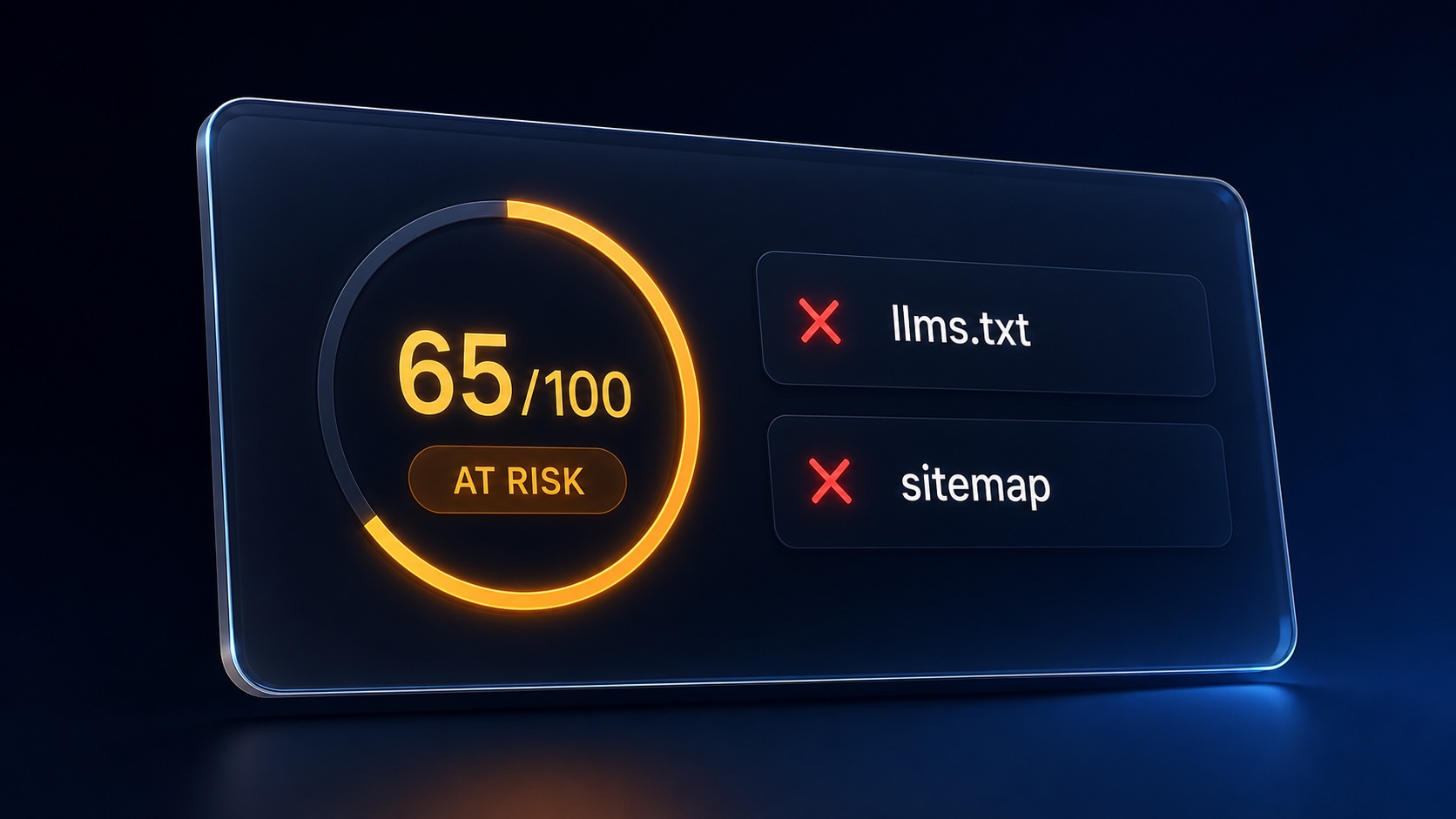
65 out of 100. “At Risk.”
No llms.txt. No sitemap. No business schema. My site — the site of a guy who literally sells AI visibility services — was semi-invisible to the machines deciding who gets recommended. I’m publishing that number because that’s the point: almost everyone is failing this test right now, and almost nobody knows it.
What the scanner actually checks (in 30 seconds, free, no email)
It reads your site the way an AI engine does and grades 12 signals in plain English:
- Can AI even get in? Some sites block GPTBot, ClaudeBot, and PerplexityBot in robots.txt without knowing it. That’s a self-inflicted disappearing act.
- Do you have an llms.txt? The new standard file that tells AI assistants who you are and why to recommend you. Most sites: no.
- Does AI know what your business IS? Structured data (schema) is how machines learn your name, location, and services. No schema = the AI is guessing.
- Do you answer questions? AI answers are stitched from Q&A content. Sites with no FAQ rarely get quoted.
- Can crawlers read your words? If your beautiful site loads everything with JavaScript, most AI crawlers see a blank page. One site in my own portfolio exposed just 120 words.
The uncomfortable truth about this moment
Here’s the part I care about, and the reason I don’t write pure-hype AI posts: this shift is going to quietly hurt a lot of good people. The bakery with the JavaScript menu. The contractor whose 15 years of reviews live on a site AI can’t parse. They did nothing wrong — the ground moved under them.
But the same shift is the biggest visibility opportunity since early Google. The fixes are not rocket science: a text file here, a schema block there, an FAQ page written in the words your customers actually use. The businesses that do this in the next six months get cited while their competitors vanish. Cited brands are already earning about 35% more clicks. This is a rare window where an afternoon of unglamorous work beats a decade of incumbency.

Run your scan. Right now. It’s free.
→ Scan your site free at the AI Search Readiness Scanner — 30 seconds, no signup, nothing stored.
If you score under 80, you have gaps costing you AI visibility today. Fix them yourself with the toolkit at All Clear Digital, or get the done-for-you audit at Lexington Digital.
As for me — I’m taking my own medicine. llms.txt, sitemap, and schema go live on this site this week. I’ll post the before/after score.
A New Day
A New Day: Building Legacy, Not Just Launches
Today isn’t just another day to work.
It’s a day to build something that matters.
After 25 years online — launching products, serving clients, and building the kind of infrastructure others dream of — I’ve decided that this next chapter won’t be about more hustle.
It’s about inspired work.
Work that leaves a mark, not just a metric.
Build Legacy, Not Just Revenue
Launching AI products and services is exciting — but let’s be honest — anyone with enough drive and a few tools can do that today.
The real difference comes when you stop chasing launches… and start designing an ecosystem.
I want to build something that shapes how others build. A body of work that outlives the moment.
That means asking a better question at the start of every project:
“Will this still matter five years from now?”
Legacy isn’t built by accident. It’s built by intention.
Work in “Signature Mode”
At this point in my journey, I’m no longer trying to out-hustle anyone.
I’m creating work that can’t be replicated because it carries my signature.
Every product. Every campaign. Every client strategy.
-
Bold vision.
-
Smart architecture.
-
Seamless integration of AI, GEO, AEO, and SEO.
-
Experiences that feel different.
I delegate the ordinary.
I obsess over the extraordinary.
Excellence isn’t about doing more.
It’s about doing what only you can do.
Build an “Inspiration Engine”
Inspiration isn’t random. It can be engineered.
That’s why I’ve created a simple daily ignition loop:
-
Morning: Review one breakthrough idea in AI or strategy.
-
Midday: Ship one high-impact action tied to a big vision.
-
Evening: Reflect on what felt energizing, not just productive.
In 30 days, momentum turns into movement.
This isn’t about discipline — it’s about rhythm.
Elevate Clients by Elevating the Game
I offer GEO/AEO/SEO services — but my real value isn’t in the service.
It’s in the strategy behind it.
I’m done just “delivering results.”
I want to architect growth systems that give my clients compounding advantages.
AI isn’t just a tool. It’s a multiplier.
When I stop thinking like a provider and start operating like a strategic partner, everything changes — for me and for them.
Lead Like a Lighthouse
Many experienced entrepreneurs spend their late seasons executing harder.
The inspired ones become beacons.
They speak.
They share frameworks.
They shape industries, not just serve them.
I intend to step forward as one of them.
My 25 years aren’t just a résumé — they’re a platform of authority.
Final Thought
“The next decade isn’t about finding the next big thing.
It’s about being the next big thing in your space.”
I have the infrastructure.
I have the experience.
Now I’m choosing inspired creation over constant execution.
This is my new era.
Not just to build — but to build with intention.
Legacy isn’t about the number of things you launch.
It’s about the depth of what you create.
Here’s to doing work that matters. Not just for today — but for years to come.
From SEO to GEO: Embracing the AI-Driven Shift in Content & Discovery
The honest answer is: not yet, or not instead of fixing what’s broken first. On September 14, 2026 I ran Google Search Console URL Inspection on every sitemap URL across seven websites I operate (one directory site sampled at 400 of its 2,291 URLs), plus 16 months of GSC Search Analytics and 90 days of GA4 data. Before I touch a single page for \”AI readability,\” the bigger problem is that Google hasn’t indexed a lot of what’s already there, and AI assistants are sending a sliver of traffic compared to what the GEO hype implies.
Why \”switch to GEO\” skips a step
A lot of GEO advice assumes your content is already indexed, crawled, and trusted, and the only remaining question is how to get cited inside an AI answer. That’s not where most sites actually are. Across the 1,482 URLs I inspected in that sweep, 419 — 28% — were not in Google’s index at all: 185 showed Discovered – currently not indexed, 57 showed Crawled – currently not indexed, and 120 were unknown to Google entirely. You can’t get cited by ChatGPT, Perplexity, or an AI Overview from a page Google hasn’t indexed.
What indexing actually looks like on real sites
A few specific things turned up in that same audit that explain why pages go missing:
- On one site, an article that had earned 2,063 Search Console impressions dropped to Discovered – currently not indexed.
- On another, 11 products were served at two URLs each, and Google picked the thin store stub as the canonical version over the detailed product page — in one measured pair, 492 words versus 81.
- One site’s sitemap hadn’t been downloaded by Google in eight weeks. In that time it grew from 209 to 279 URLs, and 84 of those URLs were unknown to Google.
- On that same site, 79 sitemap URLs reported a last-modified timestamp equal to the exact moment each request was made — which means the lastmod field was fake, not describing a real edit.
None of this is an AI-search problem. It’s a plumbing problem. GEO strategy built on top of broken plumbing doesn’t get you cited — it gets you ignored twice.
How much traffic AI assistants are actually sending
Over 90 days, across seven properties, AI assistants (ChatGPT, Perplexity, Gemini, Claude, Copilot) referred 26 of 3,842 total sessions — under 1%. That number should calibrate how much of your roadmap goes to \”get cited by AI\” this quarter versus \”get indexed and keep the traffic you already earn.\” GEO is worth doing. It is not yet the majority of anyone’s traffic, and treating it as the primary lever ahead of basic indexing health gets the order backwards.
More content doesn’t mean more citations
The old SEO instinct — publish more, rank for more — carries real risk in a GEO world, and I’ve seen it play out directly. On one site, 12 posts published in May 2026 earned 210 clicks; the 62 posts published in June 2026 earned 14 clicks combined, through September 12. Publishing faster did not produce more visibility — it produced more unindexed inventory.
That volume temptation is also where scaled AI content generation becomes a liability rather than a shortcut. Google’s spam policy defines scaled content abuse as \”many pages generated for the primary purpose of manipulating search rankings and not helping users,\” and explicitly names \”using generative AI tools or other similar tools to generate many pages without adding value for users\” and \”automated transformations like synonymizing, translating, or other obfuscation techniques\” as examples. I checked my own output against that bar: across 129 posts on three of my sites, the mean word-sequence overlap between any two posts was under 1% — they weren’t templated copies of each other. That’s the standard to hold your own content to before you scale it, not after.
What Google’s documentation actually says
Two things worth knowing before you spend time on sitemap or indexing tactics:
- Google uses the
lastmodfield in a sitemap only \”if it’s consistently and verifiably (for example by comparing to the last modification of the page) accurate,\” and it ignorespriorityandchangefreqentirely — per Google’s own sitemap documentation. Faking lastmod doesn’t speed up crawling; it just teaches Google to distrust your sitemap. - The Indexing API is not a general \”get my pages indexed faster\” tool. Per Google’s quickstart docs, \”the Indexing API can only be used to crawl pages with either JobPosting or BroadcastEvent embedded in a VideoObject.\” If a tool or consultant is pitching it as a fix for a content site’s indexing problem, that’s worth double-checking against the actual API scope.
The risk of outsourcing content to \”AI content platforms\”
This is the part of the GEO pivot that gets glossed over. Lily Ray tracked 220+ sites named as customers of AI content platforms, using third-party Ahrefs and Sistrix estimates (correlation, not proven causation). Of those sites, 54% lost at least 30% of their peak organic traffic, 39% lost at least 50%, and 22% lost at least 75% — typically within a year of the peak. That doesn’t mean AI-assisted writing is the problem. It means betting your whole content operation on automated volume, without checking whether it’s actually getting indexed and trusted, is a documented way to lose the traffic you already had.
What’s still worth doing once the foundation is fixed
Once a site is actually indexed and its sitemap is accurate, the structural advice from the original SEO playbook mostly still holds — it just needs applying with the indexing reality in mind, not as a substitute for it:
Structure for machine readers
- Use structured data (FAQPage, HowTo, Article, Organization) so both search engines and AI systems can parse what a page actually is.
- Break long content into clear chunks — question-and-answer pairs, numbered steps, short summaries — rather than one dense block of prose.
- Put the direct answer near the top. Don’t make a reader or a model dig for it.
Build verifiable authority
- Cite sources that can be checked, not just asserted claims. Models and people both reward that.
- Keep your own published numbers tied to a method and a date, so they can be verified rather than taken on faith.
- Fix duplicate-URL and canonical issues before chasing new content — a strong page that Google ignores for a thin duplicate is wasted effort twice over.
Who this shift displaces — and where the judgment still matters
The volume-content model — publish fast, publish often, let keyword density do the work — mostly employed people to produce pages at scale, and that work is exactly what generative tools now do faster and cheaper. That’s a real displacement, not a hypothetical one, and the 54%/39%/22% traffic-loss pattern above is partly the fallout of sites that leaned on that model without anyone checking whether it was working.
What opens up instead is work that a model can’t do on its own: checking whether a sitemap’s lastmod field is actually true, deciding which 11 duplicate product pages should keep the detailed version as canonical, verifying that a traffic or citation claim is backed by a method you can rerun. That’s judgment, not content volume, and it’s where a person — not an automated pipeline — still has to sit in the loop.
What to actually do this week
- Run URL Inspection (or review your existing GSC data) across your own sitemap and count how many URLs show Discovered or Crawled – currently not indexed.
- Check whether your sitemap’s
lastmodvalues are real edit timestamps or a static value stamped at request time. - Look for pages served at two URLs and confirm which one Google picked as canonical — it may not be the one you’d choose.
- Check your own analytics for AI-assistant referral sessions as a share of total traffic before building a strategy around it.
- Before scaling content output, check your own posts for near-duplicate phrasing the same way a spam classifier would.
Hello World! From SEO to AI: My New Chapter Online
From SEO to AI: My New Chapter Online
Hi, I’m Chris Slater — and this blog has been a long time coming.
For over 25 years, I’ve lived and worked online. From the early days of dial-up and hand-coded HTML to the rise of Google, social media, and now AI — I’ve seen (and helped shape) the digital world as we know it. Looking back, my biggest regret is that I didn’t blog any of it — the wins, the lessons, the mistakes, the breakthroughs. So, this blog fixes that.
A Little About Me
I’ve spent most of my professional life helping businesses grow through SEO — not just chasing rankings, but building systems that drive real results. Along the way, I’ve learned what it takes to stay relevant in an industry that never stops evolving.
Now, I’m entering a new era of my career — AI development and AI search. The web is transforming once again, and I’m fascinated by how artificial intelligence is redefining everything from how we find information to how we create it.
Why I’m Starting This Blog
This space is my chance to share — the knowledge, the stories, and the experiments. Expect insights on:
-
SEO strategies that still matter (and those that don’t)
-
AI tools and technologies I’m building or testing
-
Personal reflections on navigating change, growth, and creativity online
I’ll also be offering my services — from SEO consulting and AI-driven search strategy to custom AI integrations for digital businesses. But more than that, I’m here to connect.
Let’s Build Something Together
If you’re interested in collaborating, learning, or just talking about where the web is headed — reach out. I’m always up for new ideas, partnerships, or simply making new friends in this ever-evolving digital landscape.
Here’s to the next 25 years — and finally, to documenting the journey.
— Chris Slater
SEO Specialist, AI Developer, and Lifelong Web Explorer